
Using an LLM and Embeddings to Study Collective Cultures
The United States is a decidedly individualistic culture. This is a cultural trait common in Western nations like Canada, the UK, and Australia. In an individualistic culture, the fundamental unit is the individual. While individuals in these cultures do care about their families and friends, the goals of an individual are prioritized over the goals of the group:
- Whom will I marry?
- Where will I study?
- Where will I live?
- What will I do for work?
Conversely, the ancient societies found in the Bible are collective. They are also considered agrarian (agriculture based economies) and high-context (where speech between people assumes a lot of shared knowledge and reading between the lines) (Richard and James, 2020). This means that while individual actions are important, the family and culture in which a person lives is where they find their identity. Thus, the goals of the group are prioritized over the goals of the individual:
- How will my marriage benefit our tribe?
- What wisdom can I provide to my family?
- Where will we live?
- How will my occupation strengthen our group?
America in the industrial revolution was industrial, individualist and low-context (where speech is more blunt and assumes little shared knowledge). Individuals raced to build their own business empires often in spite of their upbringing (i.e., rags to riches).
However, the Deep South, particularly in early America, is somewhere in between the collectivism of ancient societies and American individualism. Individualism was taking root, but it still largely existed in an agrarian (cotton, tobacco) and high-context setting. Anyone who has been told “bless your heart” knows that it can mean many different things based on the tones and context…
Related Traits
I hypothesized that as societies move from collectivism in favor of individualism that they would also become less agrarian and embody low-context communication. This brings about anthropological “poles” I am interested in studying. My research question is as follows:
To what extent do collective societies predict the coexistence of agrarian economic structures and high-context communication styles?
Methods
To determine these relationships, I want to measure the correlation between three anthropological poles:
- Collectivism to Individualism
- Agrarianism to Industrialization
- High-Context to Low-Context Communication
I selected 5 texts available on Project Gutenberg as .txt files which I can chunk
and embed using an embedding model:
| Book | Summary | Expected Pole Alignment |
|---|---|---|
| KJV Bible | Scripture, lots of subtext and cultural influence, honor-shame. | Agrarian, Collective, and High-Context |
| The Southerner | Early 20th-century Southern text tracking family legacy and honor/shame. | Agrarian, Collective, and High-Context |
| O Pioneers | Midwestern frontier farming completely stripped of collective safety nets, highlighting radical self-reliance. | Agrarian, Individualist, and Low-Context |
| The Jungle | Chicago slaughterhouses; focuses heavily on the mechanics of industrial wages and the explicit push for labor unions. | Industrial, Collective, and Low-Context |
| The Iron Heel | Set in a gritty industrial future. London focuses aggressively on individual steel/rail oligarchs and raw corporate power. | Industrial, Individualist, and Low-Context |
These 5 texts are then chunked into segments of 500 words and passed to an embedding model,
specifically, embeddinggemma from Google. For the uninitiated, an embedding model is an essential
component of modern AI systems. Effectively, they are mathematical functions which accept
text of arbitrary length (e.g., a few paragraphs) and return a vector (a list of numbers)
of a fixed length. The more similar the list of numbers, the more similar the text (even
if the text is of different lengths).
| Example Text | Example Embedding (Numeric Representation) |
|---|---|
| The quick brown fox… | [0.12, 0.34, 0.91] |
| The brown quick fox… | [0.11, 0.44, 0.89] |
| A tall building was… | [0.95, 0.01, 0.02] |
Notice how the first two texts above have more similar numeric representations than the third text.
In an AI system, embeddings are used to determine which documents or web pages (out of thousands of potential documents) are relevant to the question. This both improves the speed and reliability of AI systems. Note: this mechanism is known as retrieval augmented generation (RAG). Other systems exist, however, RAG remains very popular.
Using these embeddings from the texts above, I will compare them to statements
discussing individualism, industrialization, and language context. These
statements are generated by an LLM (specifically gemma4 from Google) using the
following prompt template:
You are an expert cross-cultural anthropologist and linguist.

Generate exactly 10 distinct, highly descriptive phrases or
micro-scenarios that represent an extreme baseline for this trait:
{description}

CRITICAL RULES:
1. Isolate the concept. Make it pure, focused, and extreme.
2. Keep them brief (8-15 words each).
3. Return ONLY valid JSON matching the template below.
4. Do not include any reasoning, conversational text,
   markdown formatting blocks, or chatter. Only raw JSON.
This prompt would generate responses like:
{
  "phrases": [
    "Ancestral seeds dictate the planting cycle and harvest timing.",
    "The communal field dictates seasonal labor and land boundaries.",
    "Harvest rituals bind the family to the ancestral soil.",
    "Seasonal shifts determine the rhythm of the entire community.",
    "Land ties define kinship and the obligation to the earth.",
    "Crop rotation governs the annual cycle of rural existence.",
    "The ancestral path dictates the boundaries of the cultivated land.",
    "Harvesting is a sacred, seasonal obligation of the lineage.",
    "Farming is a cyclical, inherited practice of rural life.",
    "The land dictates the rhythm of the ancestral farming."
  ]
}
I then embed the statements above and compare them to the text chunks from the 5 source documents. For example, consider the following two texts. The first is a statement generated by an LLM which corresponds to the theme of “agrarian society” which we can compare to an agrarian verse from the KJV:
- LLM Statement: “Ancestral seeds dictate the planting cycle and harvest timing.”
- Verse from KJV: “He that observeth the wind shall not sow; and he that regardeth the clouds shall not reap.”
Using embeddinggemma these two texts have a similarity of 0.4 where scores range
from -1 to 1. Texts with a score of -1 are perfectly opposite where texts with a score
of 1 are exactly the same. A score of 0.4 means these texts are related and moderately
similar (using cosine similarity). Thus we might say that this text chunk from the
KJV contains moderately agrarian themes.
import ollama
import numpy as np

llm_statement = "Ancestral seeds dictate the planting cycle and harvest timing."
kjv_verse = "He that observeth the wind shall not sow; and he that regardeth the clouds shall not reap."

llm_embed = ollama.embed("embeddinggemma", llm_statement)
kjv_embed = ollama.embed("embeddinggemma", kjv_verse)

# Note that the dot-product of two normalized embeddings is cosine similarity
np.dot(
    np.array(llm_embed.embeddings),
    np.array(kjv_embed.embeddings).T
)
# 0.40
We would then compare the same chunk from the KJV to statements from the two other poles (collectivism and high-context speech). This would allow us to measure how agrarian, collective, and contextual this chunk from the KJV is. If we repeat this for enough chunks (across all 5 input texts from the Gutenberg Press) then we can start to measure correlations between the three poles.
Determining Scores for Each Text Chunk
| Spectrum | Formula |
|---|---|
| Agrarian | Avg(10 Agrarian) |
| Collective | Avg(10 Collective) |
| Context | Avg(10 High-Context) |
In the end, I obtain a table like this (this is a polars data frame). Note also that each id
or row corresponds to a 500 word text chunk in one of the 5 texts (e.g., the KJV or a passage
in The Jungle).
shape: (2_070, 4)
┌──────┬───────────┬────────────┬───────────┐
│ id   ┆ Agrarian  ┆ Collective ┆ Context   │
│ ---  ┆ ---       ┆ ---        ┆ ---       │
│ u32  ┆ f32       ┆ f32        ┆ f32       │
╞══════╪═══════════╪════════════╪═══════════╡
│ 1736 ┆ 0.012881  ┆ -0.015657  ┆ -0.028202 │
│ 280  ┆ 0.091485  ┆ 0.094038   ┆ 0.07678   │
│ …    ┆ …         ┆ …          ┆ …         │
│ 1179 ┆ 0.048913  ┆ 0.06191    ┆ 0.03391   │
│ 1816 ┆ -0.011104 ┆ -0.009879  ┆ -0.016108 │
└──────┴───────────┴────────────┴───────────┘
Results
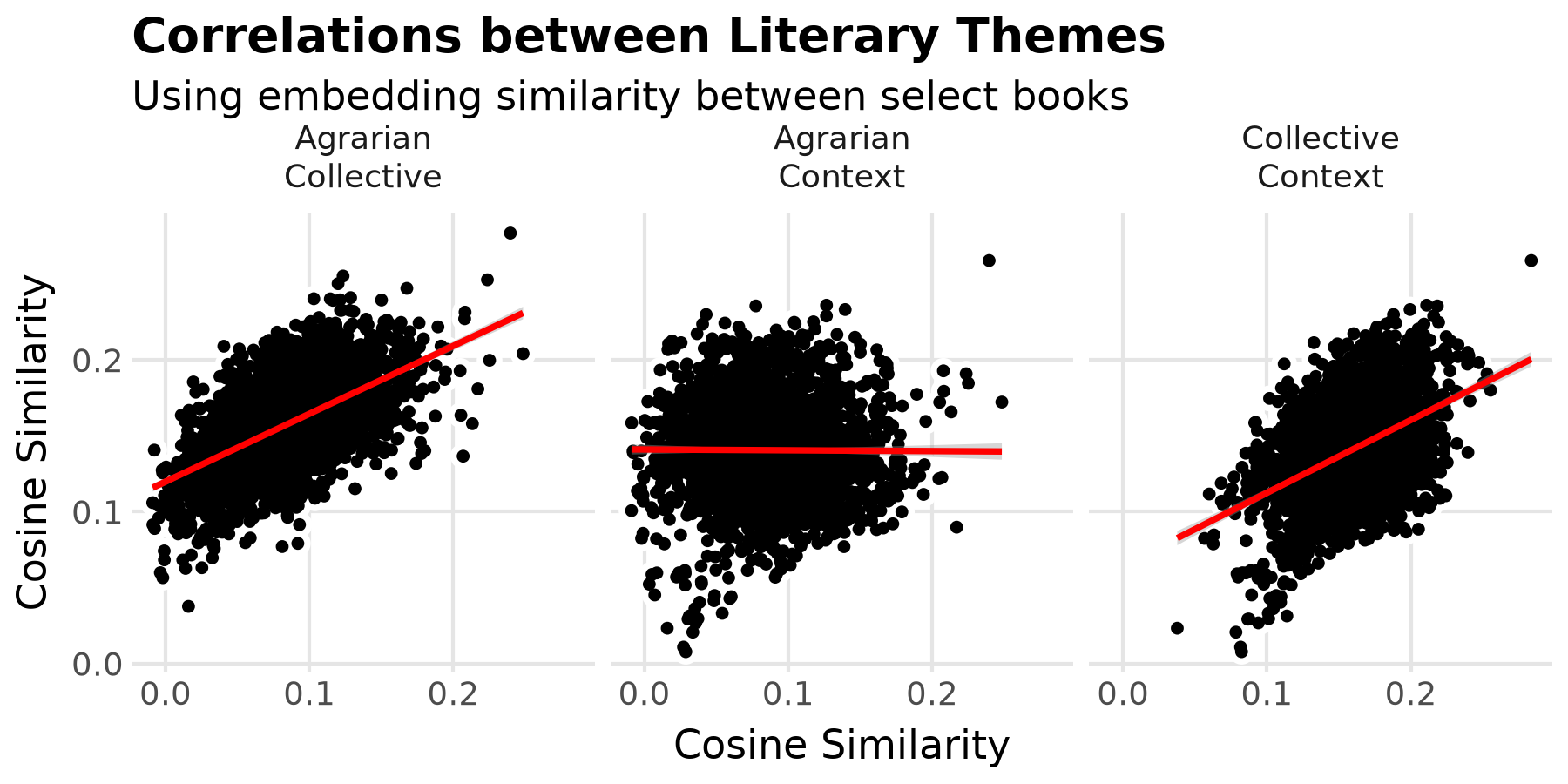
Using the similarity scores across over 2000 text chunks, I can determine the Pearson correlation between each of the three combinations of scores:
| Dimension A | Dimension B | Pearson Correlation |
|---|---|---|
| Collective | Context | 0.44 |
| Collective | Agrarian | 0.57 |
| Context | Agrarian | -0.01 |
The data supports the core hypothesis: collective cultures consistently align with both agrarian societies and high-context communication styles. However, the relationship between agrarian economic structures and high-context communication is effectively zero (for example, the more direct communication style of the agrarian Midwest). This is further supported by the visualization below:
Limitations
- It’s worth noting that individualistic cultures exhibit collectivism (e.g. sports teams, state pride, nationalism) and collective cultures exhibit individualism (selfishness, individual pride) but thinking of cultures along a spectrum of collectivism and individualism is helpful as a mechanism.
- Embedding models and language models are used to generate the results; while useful they may contain inherent biases and limitations for generating and measuring text similarity.
- The selection of 5 texts is intentional, but limited. A more robust study would include more texts.
- I could further weight the text chunks to provide a more even distribution of literature styles.
- I could have included a “control pole” which should be totally unrelated to the three anthropological dimensions that should have a near-zero correlation.
- Given the relatively small sample size (~2000 observations) I could have bootstrapped the results or used more chunks to generate a confidence interval.
- This provides a cross section of texts popular in America. Results in other languages and periods might provide vastly different results.
Code
Note: this was built using a uv virtual environment. It also assumes an Ollama server
is running with the OLLAMA_HOST environment variable is set with embeddinggemma and
gemma4:e2b is loaded. A GPU is strongly encouraged for the Ollama instance.
#### Setup ####

import json
import tqdm
import ollama
import requests

import numpy as np
import polars as pl
import plotnine as p9

from functools import reduce
from numpy.typing import NDArray

CHUNK_WORDS = 500

EMBEDDING_MODEL = "embeddinggemma"
LANGUAGE_MODEL = "gemma4:e2b"

URLS = {
    "Bible KJV": "https://www.gutenberg.org/cache/epub/10/pg10.txt",
    "The Southerner": "https://www.gutenberg.org/cache/epub/19135/pg19135.txt",
    "O Pioneers": "https://www.gutenberg.org/cache/epub/24/pg24.txt",
    "The Jungle": "https://www.gutenberg.org/cache/epub/140/pg140.txt",
    "The Iron Heel": "https://www.gutenberg.org/cache/epub/1164/pg1164.txt"
}

POLES = {
    "agrarian": """
    Traditional agrarian life, seasonal crop reliance,
    rural harvesting, land ties, ancestral farming
    """,
    "collective": """
    Group harmony, sacrificing personal desires for
    family honor, community duty, filial piety, collective
    accountability
    """,
    "high_context": """
    Reading between the lines, heavily implied subtext,
    unspoken social hierarchies, indirect speech, saving face
    """
}

def get_embeddings(model: str, text: str | list[str]) -> NDArray:
    """Returns embeddings with L2 normalization"""

    result = ollama.embed(model, text).embeddings
    arr = np.array(result, dtype=np.float32)

    # Handle 1D arrays
    if arr.ndim == 1:
        norm = np.linalg.norm(arr)
        return arr / norm if norm > 0 else arr

    norms = np.linalg.norm(arr, axis=1, keepdims=True)
    norms[norms == 0] = 1.0
    return arr / norms

#### Establish Vector Store ####

chunk_embeddings = []

for book, url in tqdm.tqdm(URLS.items()):
    text = requests.get(url).text.strip().split()
    chunk_range = range(0, len(text), CHUNK_WORDS)
    chunks = [" ".join(text[i : i + CHUNK_WORDS]) for i in chunk_range]
    chunk_embeddings.append(get_embeddings(EMBEDDING_MODEL, chunks))

chunk_embeddings = np.vstack(chunk_embeddings)

#### Generate Comparisons for Similarity ####

comparisons = []

for pole, description in tqdm.tqdm(POLES.items()):

    # Prompt for pole generation
    prompt = f"""
    You are an expert cross-cultural anthropologist and linguist.

    Generate exactly 10 distinct, highly descriptive phrases or
    micro-scenarios that represent an extreme baseline for this trait:
    {description}

    CRITICAL RULES:
    1. Isolate the concept. Make it pure, focused, and extreme.
    2. Keep them brief (8-15 words each).
    3. Return ONLY valid JSON matching the template below.
    4. Do not include any reasoning, conversational text,
       markdown formatting blocks, or chatter. Only raw JSON.

    JSON Template:
    phrases
    """

    # Responses from LLM with pole statements
    response = ollama.generate(
        model=LANGUAGE_MODEL,
        prompt=prompt,
        format="json",
        options={"temperature": 0.0, "seed": 42},
    )

    # Extract embeddings for pole statements
    phrases = json.loads(response["response"])["phrases"]
    pole_embeddings = get_embeddings(EMBEDDING_MODEL, phrases)
    similarity = np.dot(chunk_embeddings, pole_embeddings.T)

    # Store as dataframe for correlation analysis
    comparisons.append(
        pl.DataFrame(similarity)
        .with_row_index(
            name="id"
        )
        .unpivot(
            index="id",
            variable_name="phrase_id"
        )
        .group_by("id")
        .agg(
            pl.col("value").mean().alias(pole)
        )
    )

#### Visualize ####

joint_similarity = (
    reduce(
        lambda left, right: left.join(right, on="id"),
        comparisons
    )
    .select(
        "id",
        pl.col("agrarian").alias("Agrarian"),
        pl.col("collective").alias("Collective"),
        pl.col("high_context").alias("Context")
    )
    .unpivot(
        index="id"
    )
)

plot_df = (
    joint_similarity
    .join(
        other=joint_similarity,
        on="id"
    )
    .filter(
        pl.col("variable") < pl.col("variable_right")
    )
)

plot = (
    p9.ggplot(
        data=plot_df,
        mapping=p9.aes("value", "value_right")
    ) +
    p9.geom_point(
        size=3,
        color="white"
    ) +
    p9.geom_point(
        size=1
    ) +
    p9.geom_smooth(
        color="red"
    ) +
    p9.labs(
        title="Correlations between Literary Themes",
        subtitle="Using embedding similarity between select books",
        x="Cosine Similarity",
        y="Cosine Similarity"
    ) +
    p9.theme_minimal() +
    p9.theme(
        panel_grid_minor=p9.element_blank(),
        plot_title=p9.element_text(face="bold")
    ) +
    p9.facet_wrap(
        facets="~ variable + variable_right"
    )
)

plot.show()

print(
    plot_df
    .group_by("variable", "variable_right")
    .agg(
        pl.corr("value", "value_right").alias("correlation")
    )
)